


The new quarter has begun with continuing focus on the core issue for the US stock market, namely whether the hyperscalers will be able to monetise their AI capex which is now predicted to be US$723bn this year for the four major US hyperscalers, and US$993bn next year.
Meanwhile there is no sign of slowing as yet from the latest results.
TSMC, for example, in Taiwan is predicting its capex will rise to US$60-64bn this year while market consensus is forecasting US$80-85bn next year.
So long as the AI capex arms race continues the key beneficiaries will likely remain the picks and shovels trade (i.e. the people being paid for the capex not the companies spending the money).
The market has understood this, as seen in the chart below of the three DRAM makers’ massive outperformance over the hyperscalers since the AI capex arms race began at the start of 2023, even allowing for the sharp sell-off in July.
The four hyperscalers have risen by 219% since the start of 2023, compared with a 762% gain for the three dominant memory makers, namely Micron, Hynix and Samsung Electronics.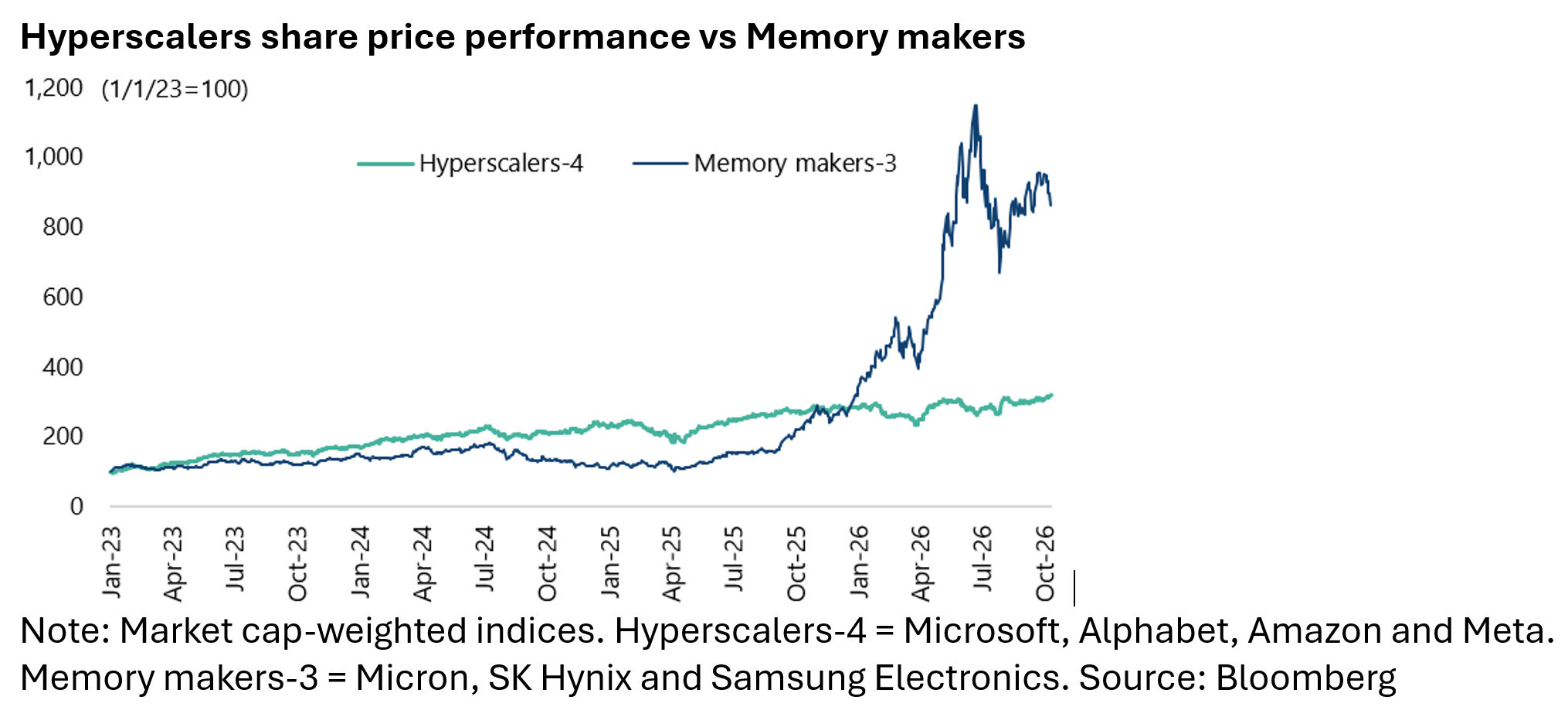
Long term this writer would still rather own the picks and shovels even allowing for the huge cyclicality of these stocks.
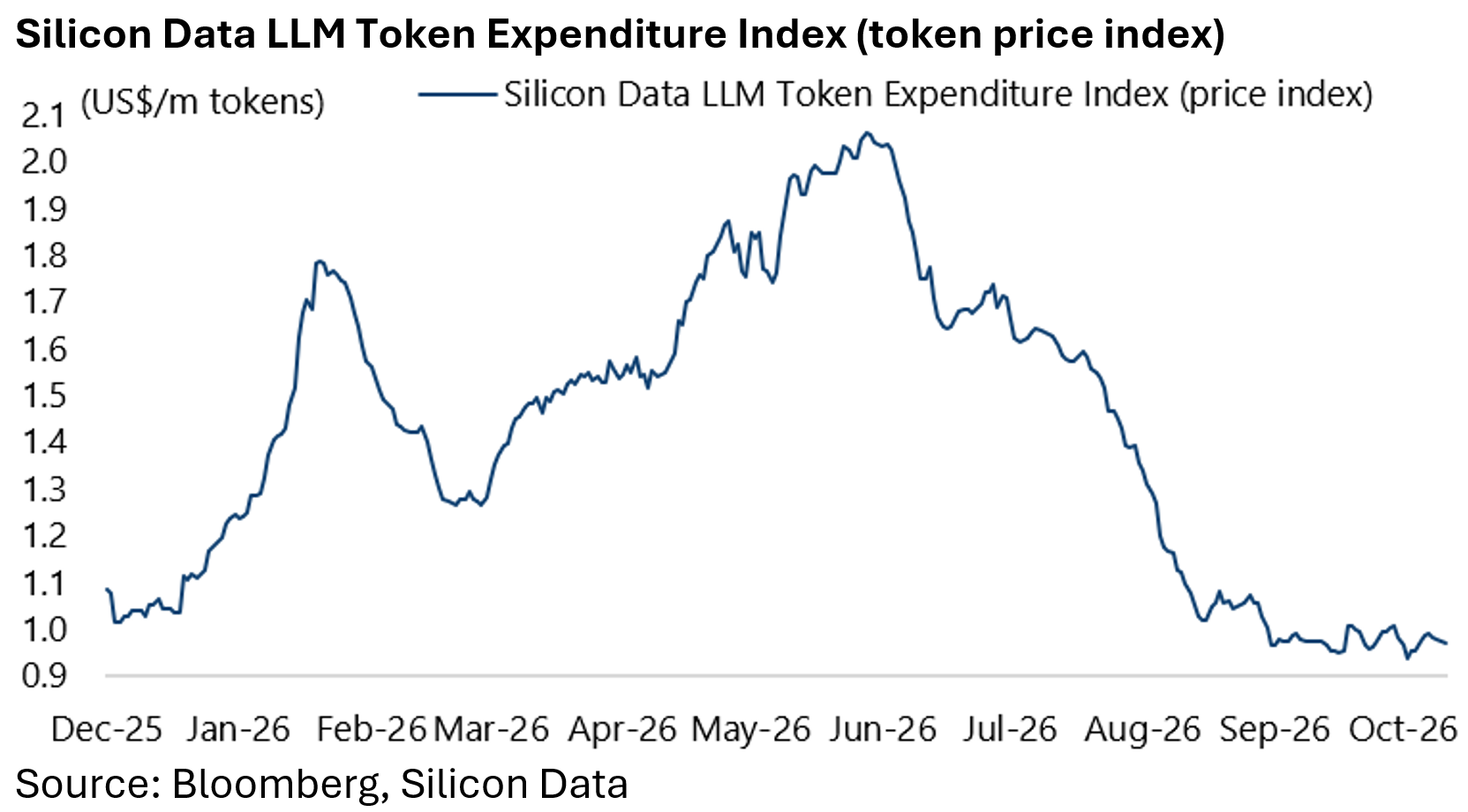
This is because the demand for compute will keep growing even as the cost of tokens continues to collapse.
Thus, the Silicon Data LLM Token Expenditure Index, which measures the usage-weighted average token price, has declined by 53% from the peak reached in late May.
Whereas this writer has no idea which of the hyperscalers, if any, are going to be successful monetising their AI capex.
Nor for that matter does the US stock market.
A few months ago, Alphabet was the favoured name because of the perceived success of Gemini.
Then it was Amazon with the big increase in its cloud revenues.
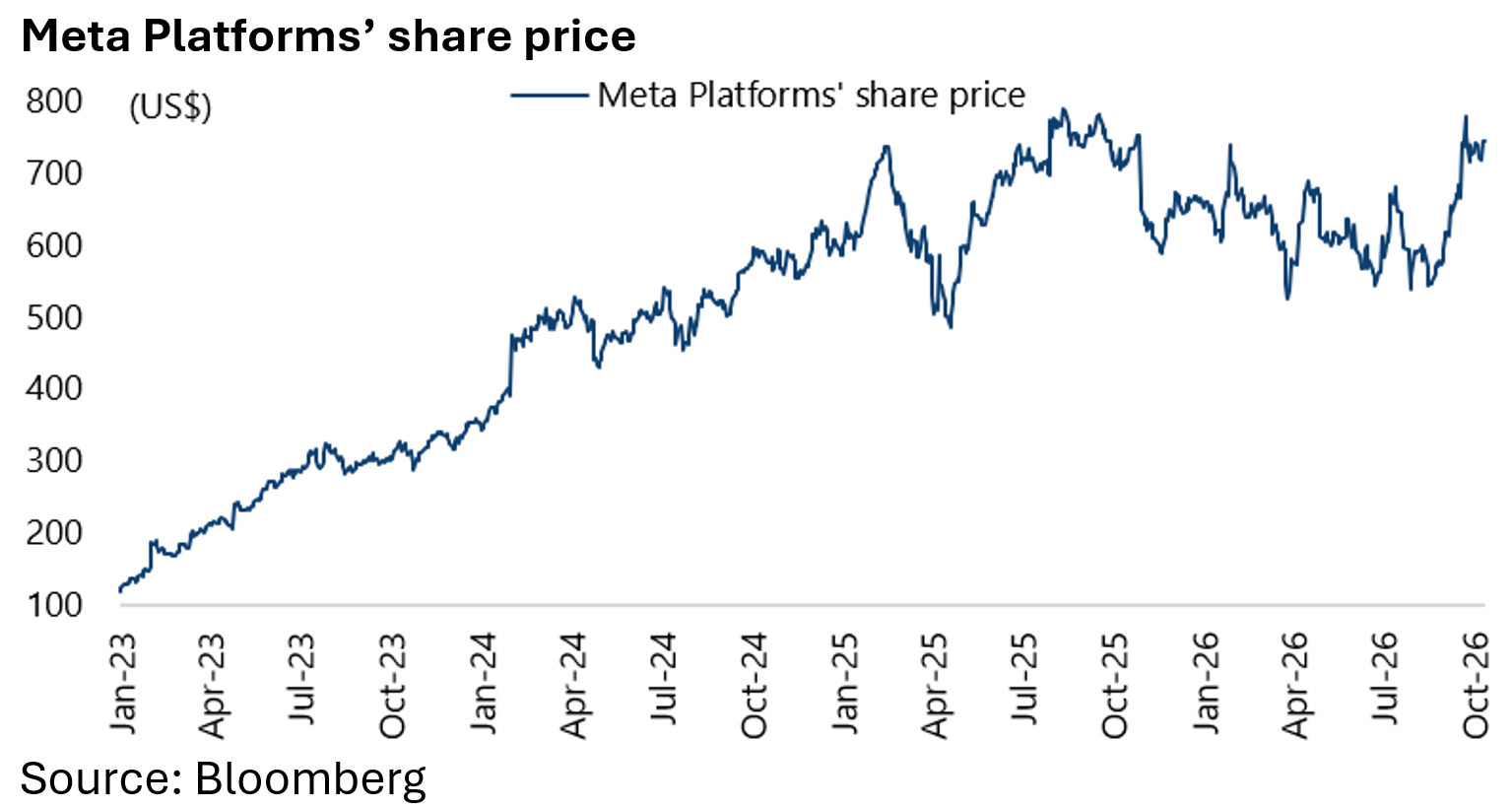
More recently, it has been Meta with the successful launch of Muse, the perceived most successful consumer application yet.
Still the perceived success of Muse, which has led to a 21% increase in Meta’s share price since Muse was launched on 8 September, is not necessarily an endorsement of the massive capex pouring into data center construction.
Indeed, it is worth recalling that Meta reportedly initiated negotiations with Anthropic in July on leasing up to US$10bn of its data center computing capacity over two years (see New York Times article: “Meta in Talks to Lease Computing Power to Anthropic in Potential $10 Billion Deal”, 17 July 2026).
Hyperscaler Multiples Under Pressure
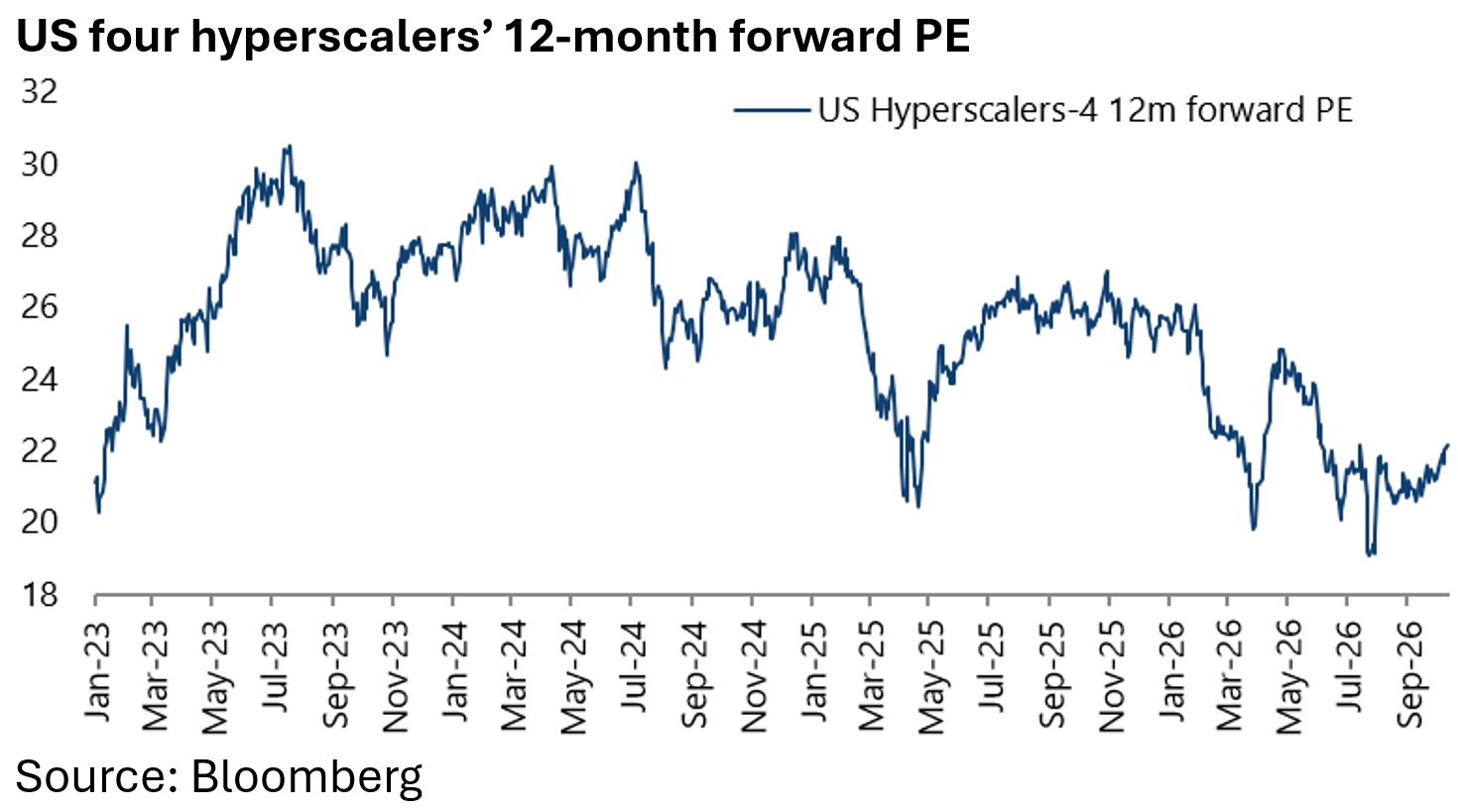
Meanwhile the hyperscalers’ valuations have derated because the market understands they will no longer be free cashflow positive on their current spending plans.
The four hyperscalers now trade on 22.2x 12-month forward earnings, down from 27.0x in late October 2025.
The four major hyperscalers’ aggregate free cash flow has declined from US$60bn in 4Q25 to only US$6.7bn in 2Q26 and is forecast by consensus to fall to negative US$13bn in 3Q26, while their aggregate capex has risen from US$72bn in 1Q25 to US$165bn in 2Q26 and a forecast US$200bn in 3Q26.
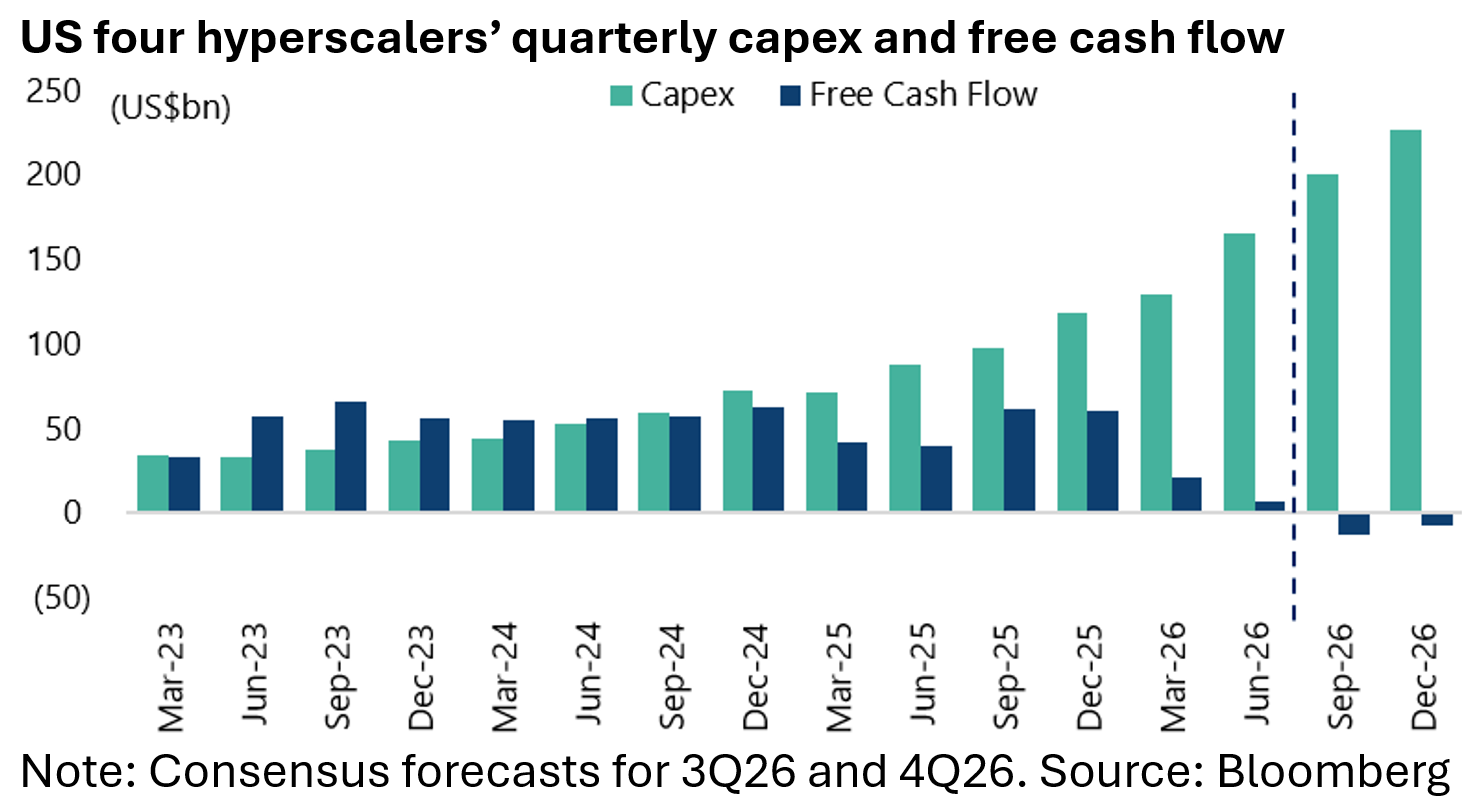
This is why the next quarterly earnings announcements for the hyperscalers due to commence on 21 October will provide the next stress test for the AI story in general.
All of these four companies are not only spending their cashflow, they are also increasingly borrowing money, with the exception of Microsoft.
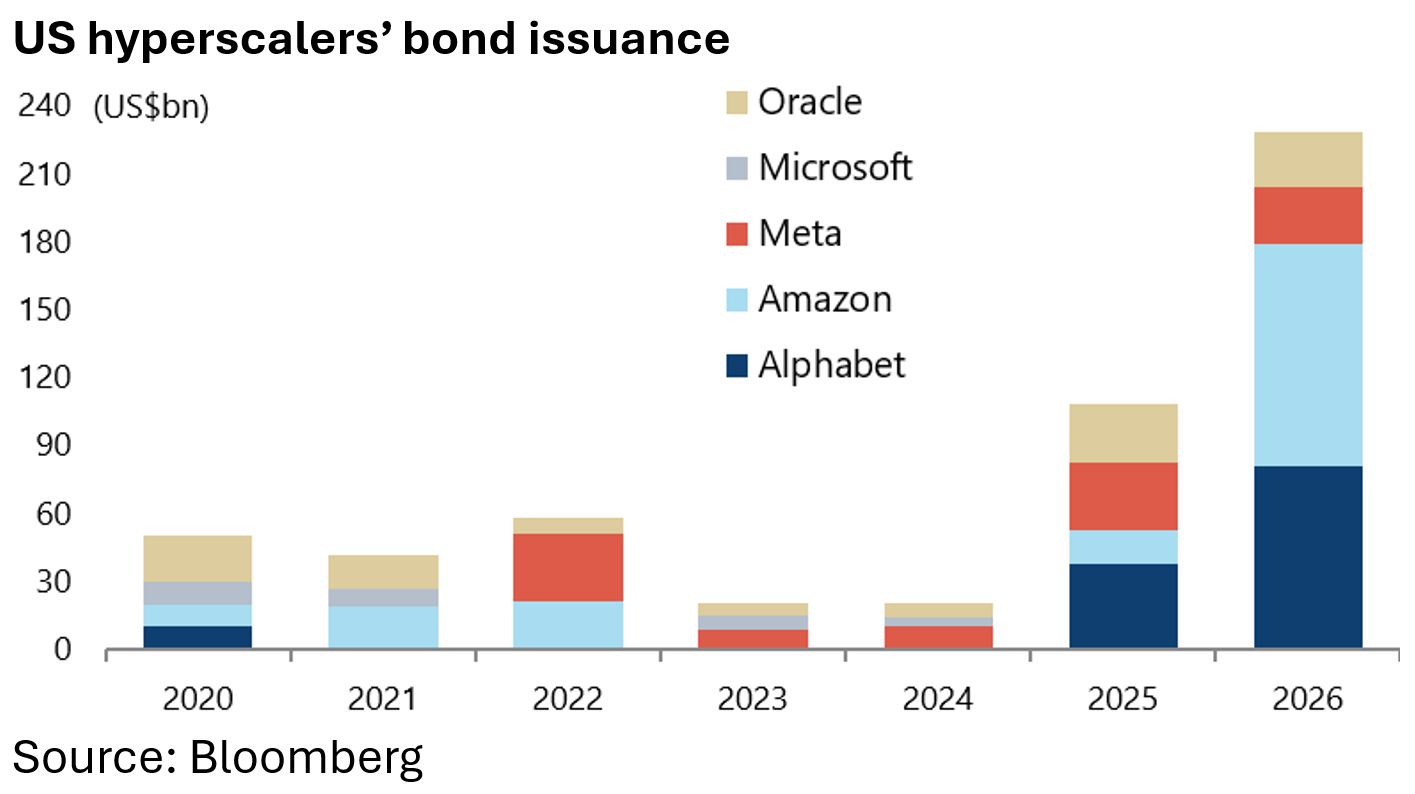
The four major US hyperscalers have issued US$204bn worth of bonds so far this year, compared with US$83bn in 2025, according to Bloomberg. Alphabet, Amazon and Meta issued US$81bn, US$98bn and US$25bn year-to-date, while Microsoft has not yet issued any bonds. In addition, Oracle has also issued US$25bn of bonds year-to-date.
Hyperscaler Credit Spreads Need to Be Monitored Closely
If this is one warning signal, another is off balance sheet commitments. An interesting Moody’s report published in February highlighted how the top five US hyperscalers (Moody’s includes Oracle) have accumulated US$662bn in future data center lease commitments not yet commenced that are not current liabilities and therefore sit off their balance sheets (see Moody’s report: “Hyperscalers’ reported AI-related lease commitments may understate economic risk”, 23 February 2026).
This is up from US$152bn at the end of 2023.
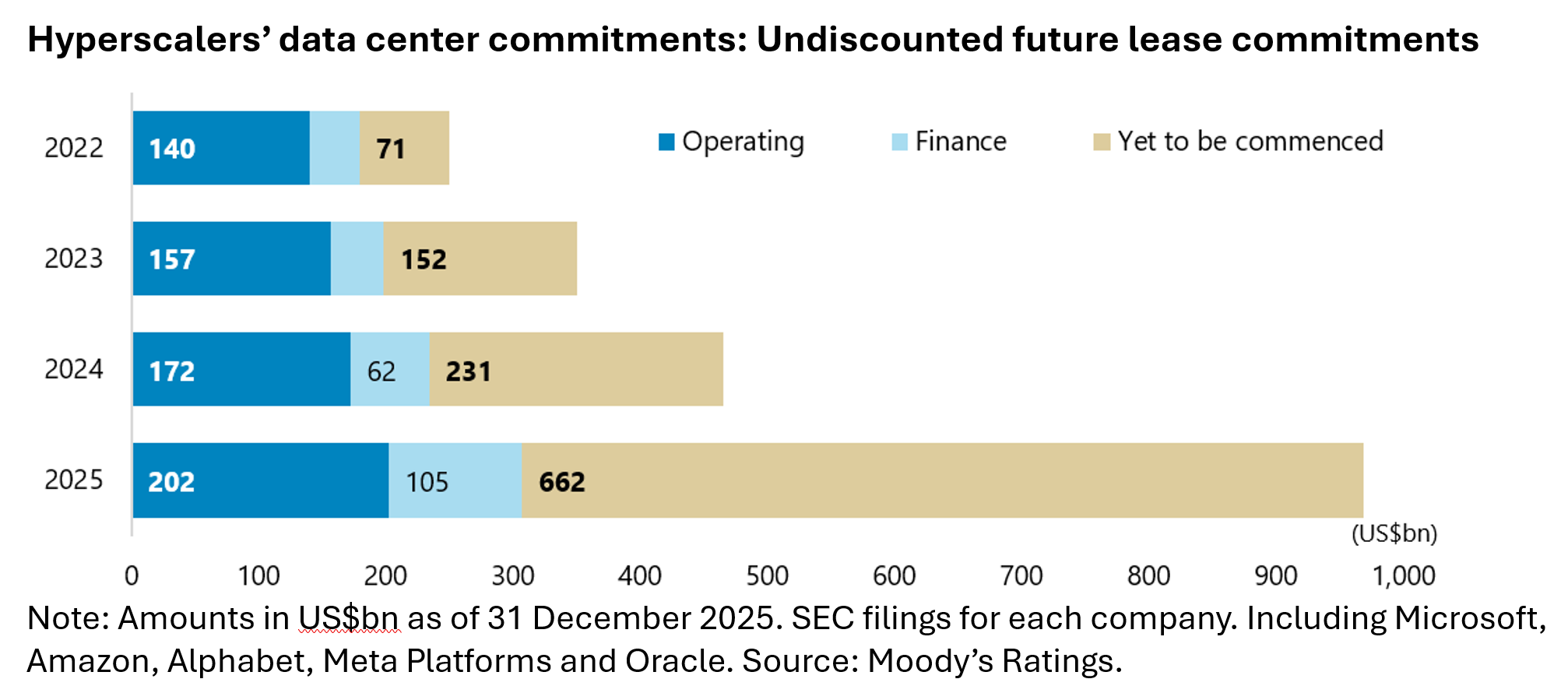
The report calculated that the amount of leases not yet on the balance sheet was equivalent to 113% of the hyperscalers’ most recent adjusted debt.
Including other commitments, the total undiscounted future lease commitments reached US$969bn at the end of 2025.
A more recent Nikkei study concluded that the five hyperscalers’ so-called hidden debt, which does not appear on their balance sheets, totaled US$1.65tn in the most recent quarter, exceeding the roughly US$1.35tn in debt reported on their balance sheets (see Nikkei Asia article: “Five US tech giants’ hidden debts soar to US$1.65tn on opaque AI funding”, 21 July 2026).
Under accounting rules, GPUs and servers under long-term contracts that have not yet been delivered, as well as lease agreements for data centers that are not yet operational, are treated as off-balance-sheet items.
All this is why the biggest risk to the AI trade will come if and when markets suddenly no longer want to fund the capex.
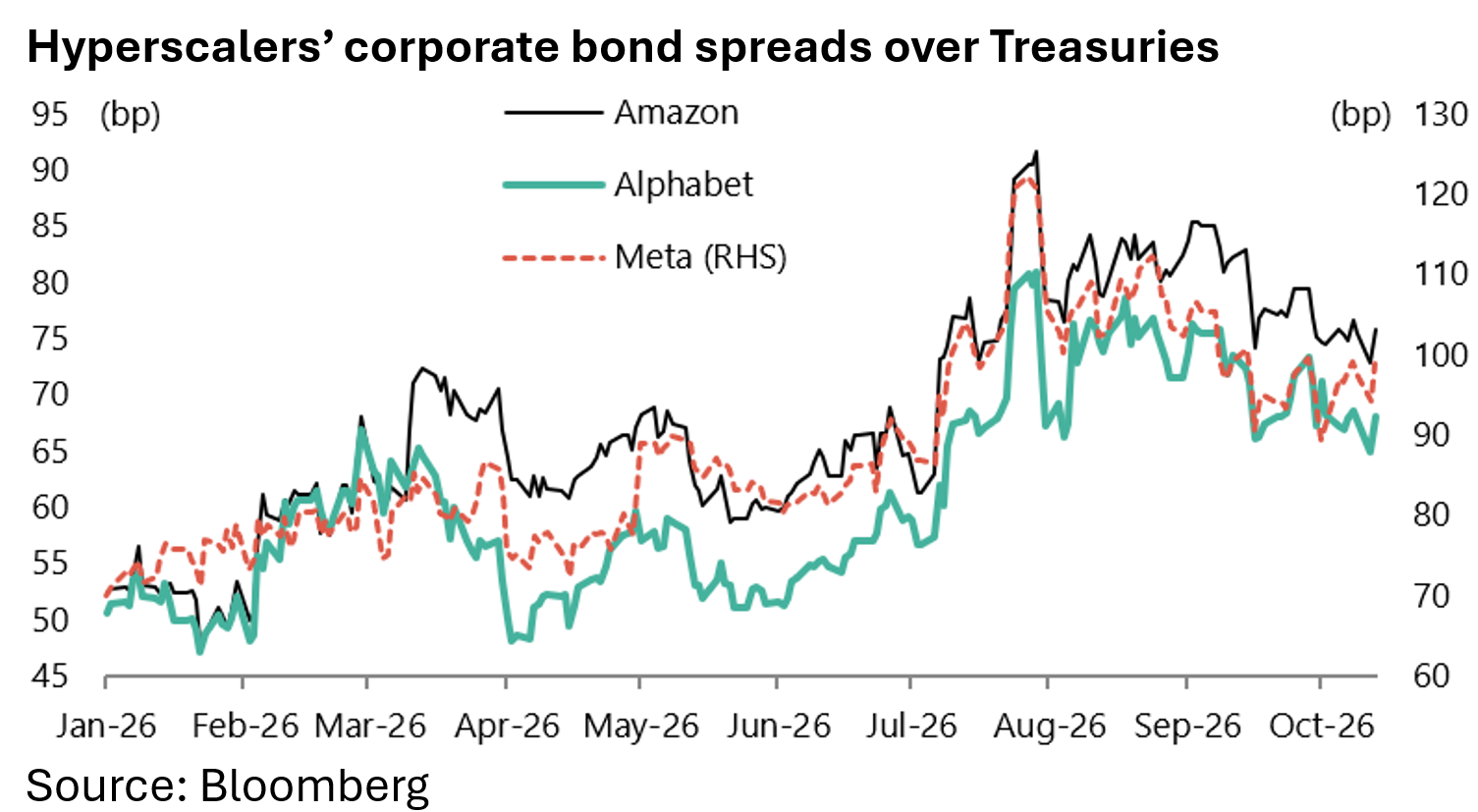
For this reason, it has become critical to monitor credit spreads going forward, most particularly of those companies involved in AI capex, including constructing data centers. Amazon, Alphabet and Meta’s corporate bond spreads over Treasuries have risen from 60bp, 51bp and 80bp in early June to 76bp, 68bp and 99bp respectively.
AI Capex in a Global Context
Meanwhile, it is worth highlighting again the sheer scale of the projected AI capex in a macro context.
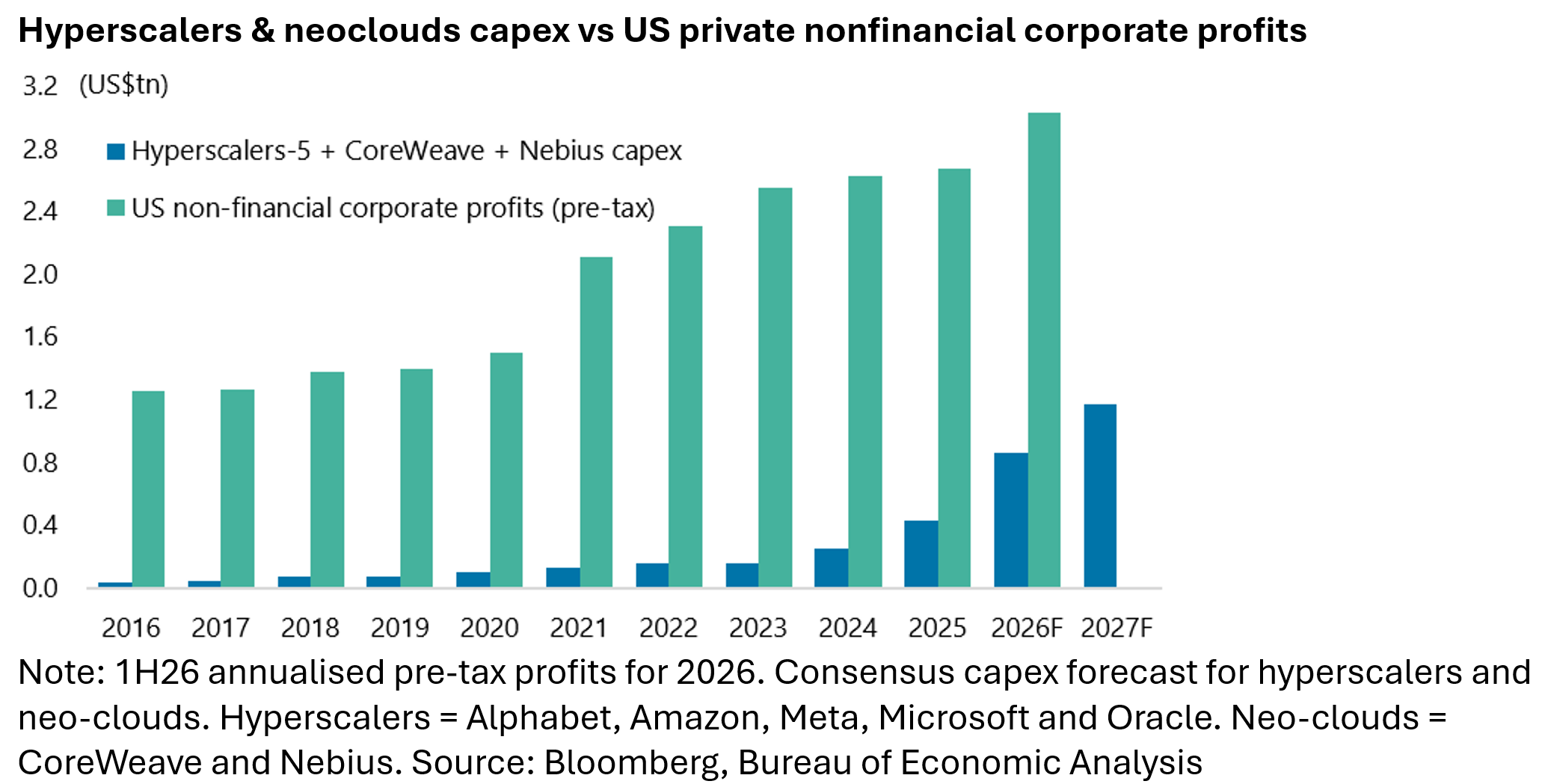
The market now expects an estimated US$1.2tn of capex in 2027, if Oracle and the neo-clouds are included.
This US$1.2tn number represents about 3.6% of US GDP and about 25% of US non-residential fixed investment.
It is also, quite remarkably, equivalent to 39% of total pre-tax profits of all US non-financial companies, not just listed ones.
Then there is the issue of the circular financing arrangements.
The always sensible Bank of International Settlements (BIS) warned about this in its latest Annual Economic Report published on 28 June. It is worth directly quoting a few sentences from that report:
“The opacity of AI-sector financing compounds these vulnerabilities. Hyperscalers, chip makers and AI labs are linked through a complex web of private arrangements. The most prominent is circular financing: chip makers and hyperscalers take equity stakes in AI labs or neocloud providers, who in turn commit to multi-year purchases of chips or computing power. Data centre construction is increasingly outsourced to third parties that lease facilities back to hyperscalers on long-dated contracts with embedded exit clauses. The terms of such deals are typically poorly disclosed, with risks of the same asset being pledged multiple times. Together, such arrangements account for a sizeable share of sector-wide financing and forward revenue.”
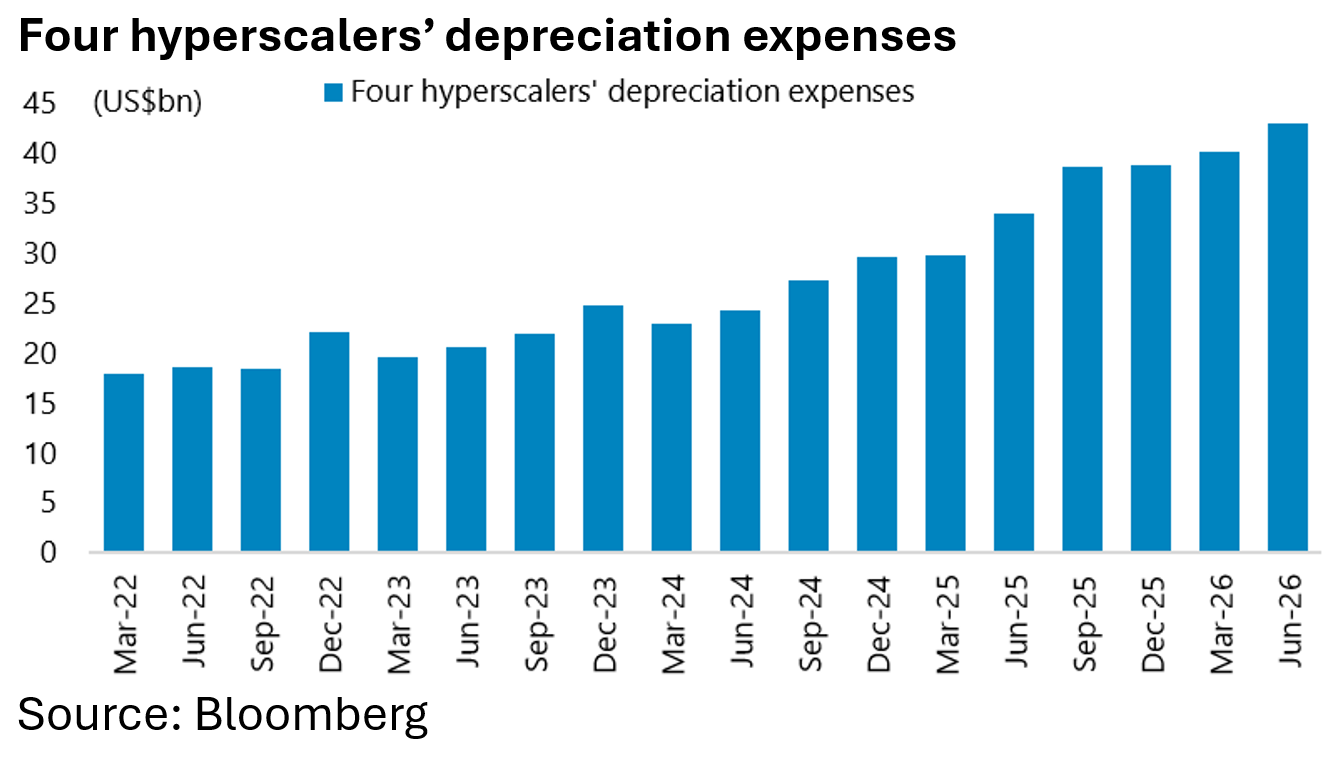
It also needs to be stressed again that the earnings from the AI capex boom are front-end loaded in the sense that the profits of the picks and shovels plays are booked up front but the hyperscalers and related parties remain in no hurry to account for that spending. In this technical sense, the profits of the latter are overstated though the depreciation bill of the hyperscalers is rising.
The four major hyperscalers collectively spent US$165bn on capex in 2Q26. But their depreciation expenses were “only” US$43bn, though up 26% YoY.
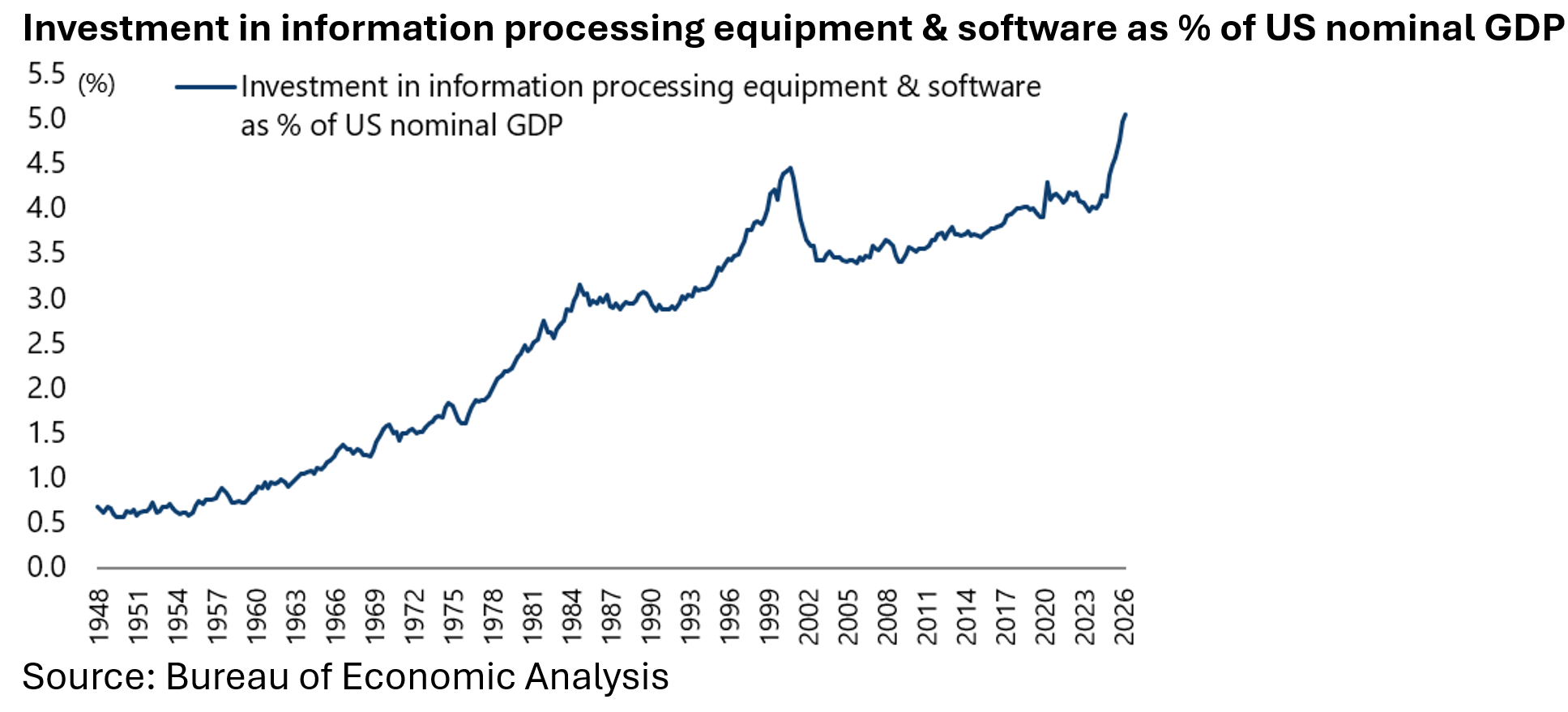
Meanwhile, in terms of the all-important question of the duration of the continuing AI capex arms race, the chart below shows that in macro terms the current cycle is now bigger relative to the US economy than at the peak of the late 1990s’ Dot-com boom.
Investments in US information processing equipment and software as a percentage of nominal GDP rose to a record 5.05% in 2Q26, compared with the previous peak of 4.46% in 4Q00.
The most likely historical parallel with what is currently going on is the US railroad boom in the late 19th century.
The views expressed in Chris Wood’s column on Grizzle reflect Chris Wood’s personal opinion only, and they have not been reviewed or endorsed by Jefferies. The information in the column has not been reviewed or verified by Jefferies. None of Jefferies, its affiliates or employees, directors or officers shall have any liability whatsoever in connection with the content published on this website.
The opinions provided in this article are those of the author and do not constitute investment advice. Readers should assume that the author and/or employees of Grizzle hold positions in the company or companies mentioned in the article. For more information, please see our Content Disclaimer.
About Author