


The rout in AI stocks has continued with the only issue whether this is signalling a mid-cycle correction, in terms of a sharp slowdown in AI capex, or the end of the story entirely from an investment standpoint.
Estimates of four hyperscalers’ capex next year have yet to be cut but that is surely coming, along with related earnings growth.
Meanwhile, the newsflow on Jensen Huang and Nvidia has potentially undermined a key financier of the neocloud ecosystem. This is in spite of Huang’s extraordinary re-instatement at Nvidia seemingly at the prodding of the 47th president.
An extremely useful summary of this was provided in the attached article (see Theory Ventures article: “When the Central Bank of AI Changes Chairs” by Tomasz Tunguz, 12 November 2026).
Over the past two years, Nvidia has committed US$42bn to technology buyouts, invested US$61bn into equity stakes across 229 startups and 13 public companies and, perhaps most importantly, extended US$164.5bn in lease guarantees and cloud capacity backstops which “require capital reserves alongside US$63.1bn in customer receivables where payment terms stretch up to a year,” to quote Tunguz directly.
With such commitments, this writer is not surprised to read that Nvidia’s chief financial officer for 13 years, Colette Kress, had reservations about the scale of the financial exposure being generated by Huang’s frenetic deal-making activity.
Clearly, any move to a more conservative approach will have tightening implications across the whole AI ecosystem since Huang had become the “pied piper” of the AI trade.
The market has been quick to focus on this, and most particularly Nvidia’s role in funding the neoclouds which he valued as an alternative source of compute to the hyperscalers. A neocloud is essentially a start-up data center company.
Remember, each hyperscaler is developing its own chip with Alphabet’s TPU the most successful so far.
Since the Huang story broke, CoreWeave’s share price has corrected by 38% while its bond now yields 16.1% as of last Friday, which is starting to look existential.
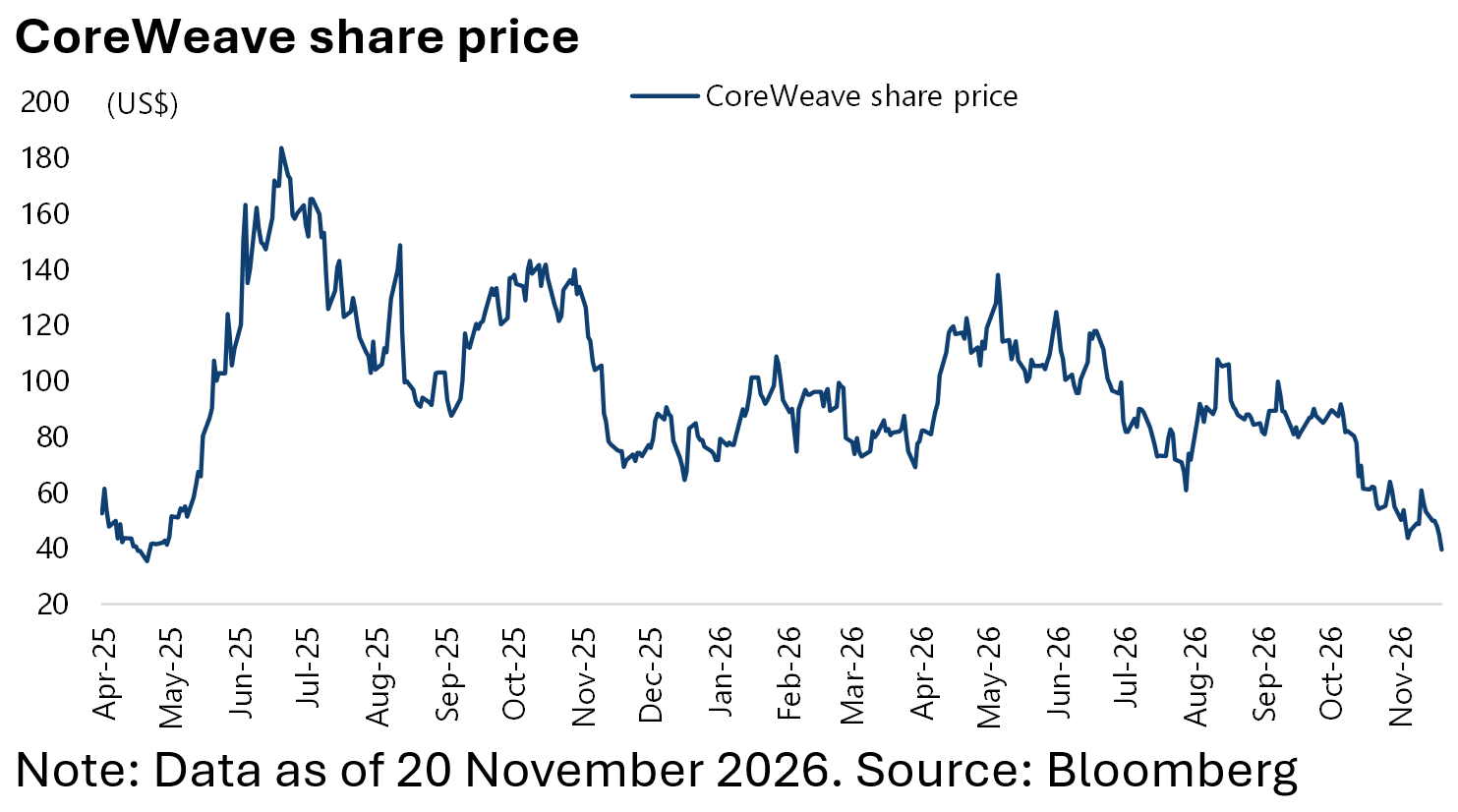
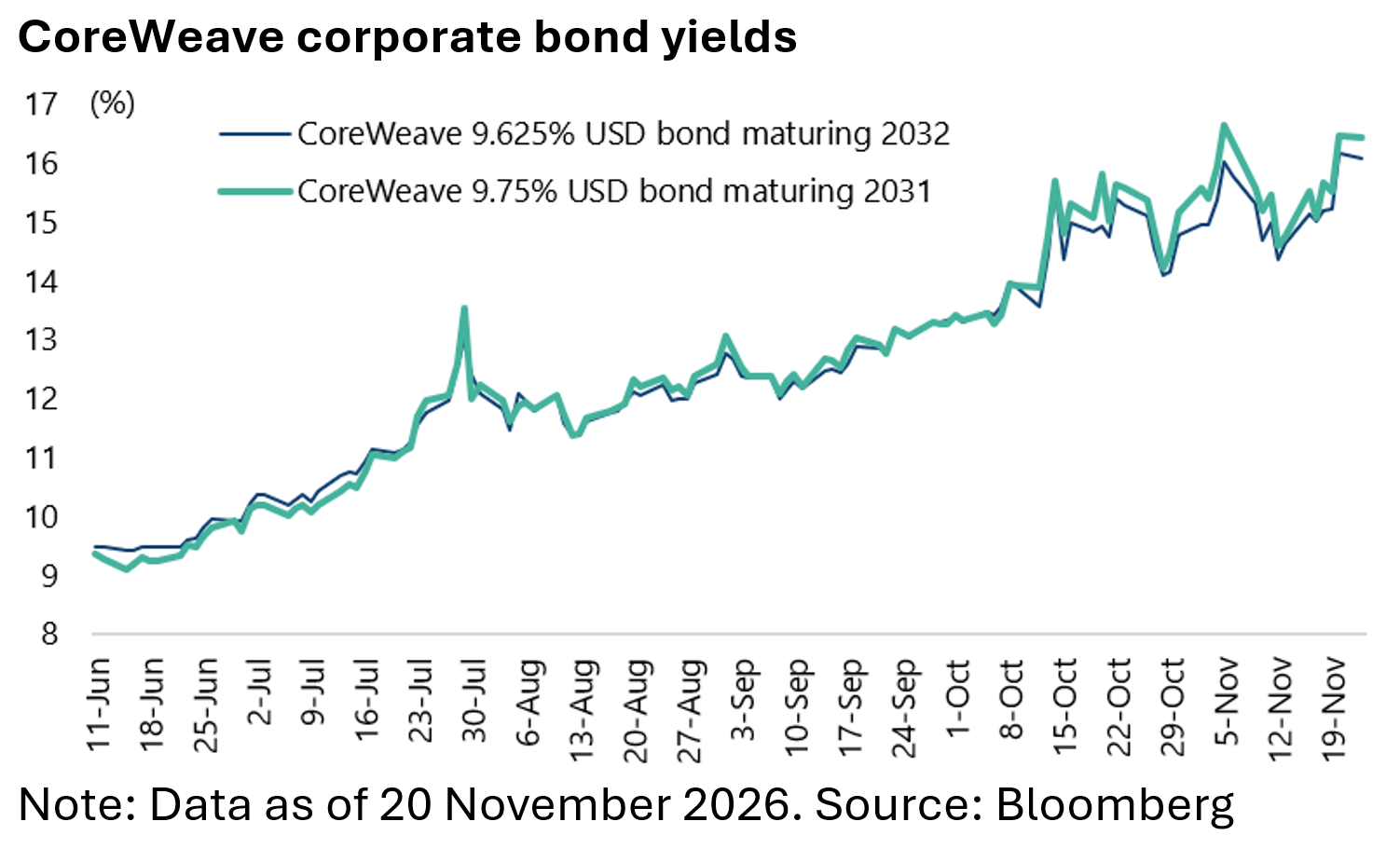
This suggests a real risk that the most speculative part of the demand for compute will disappear, which should lower compute prices for others.
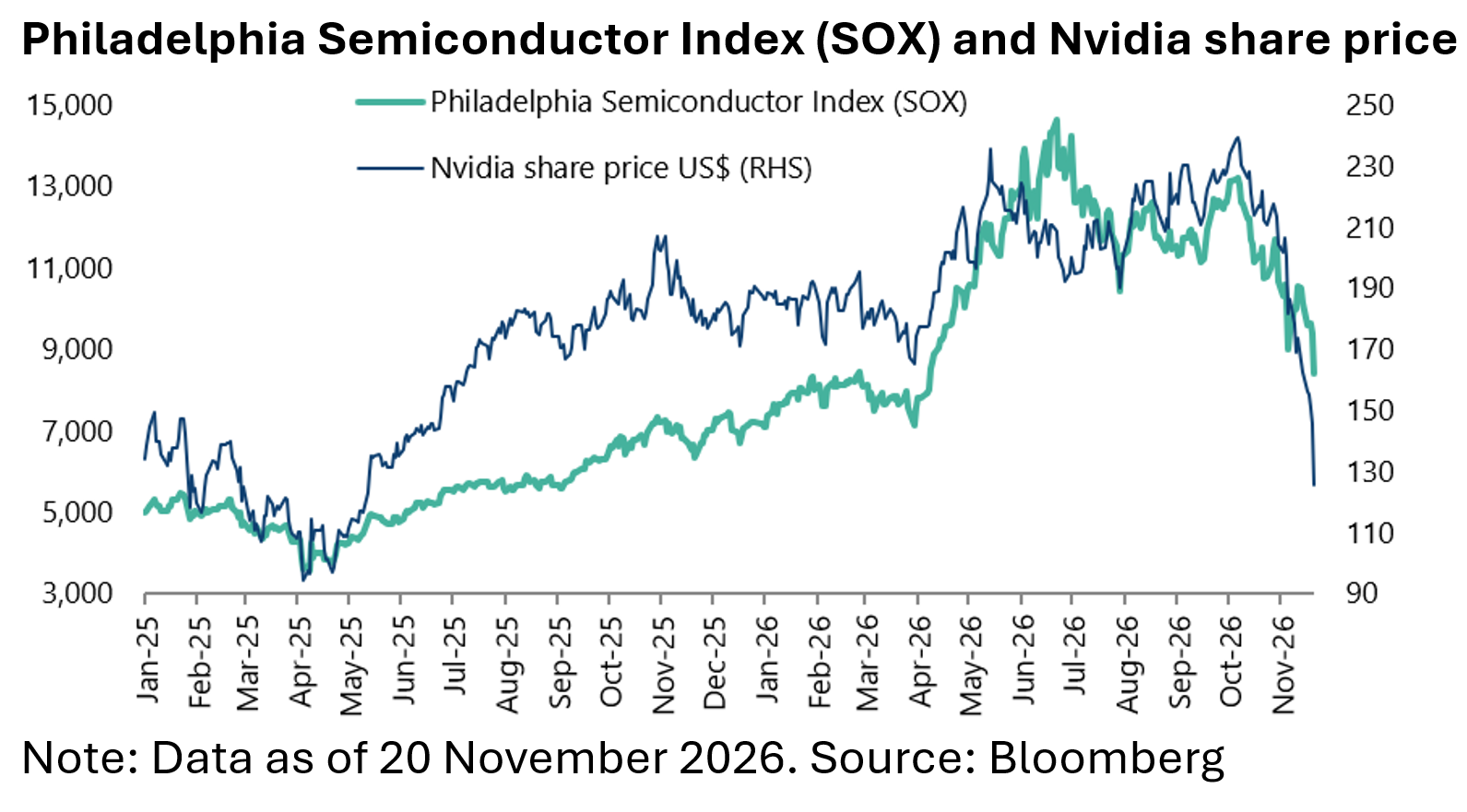
Meanwhile, The SOX Index has declined by 43% as of last Friday from the recent peak on 22 June while NVidia is down 48% from its peak on 6 October.
No Safe Haven This Time
Meanwhile, the recent risk-off action has not triggered the usual flight to quality in terms of a Treasury bond rally.
Indeed, the 10-year Treasury yield has been trading around the 5% level throughout the sell-off.
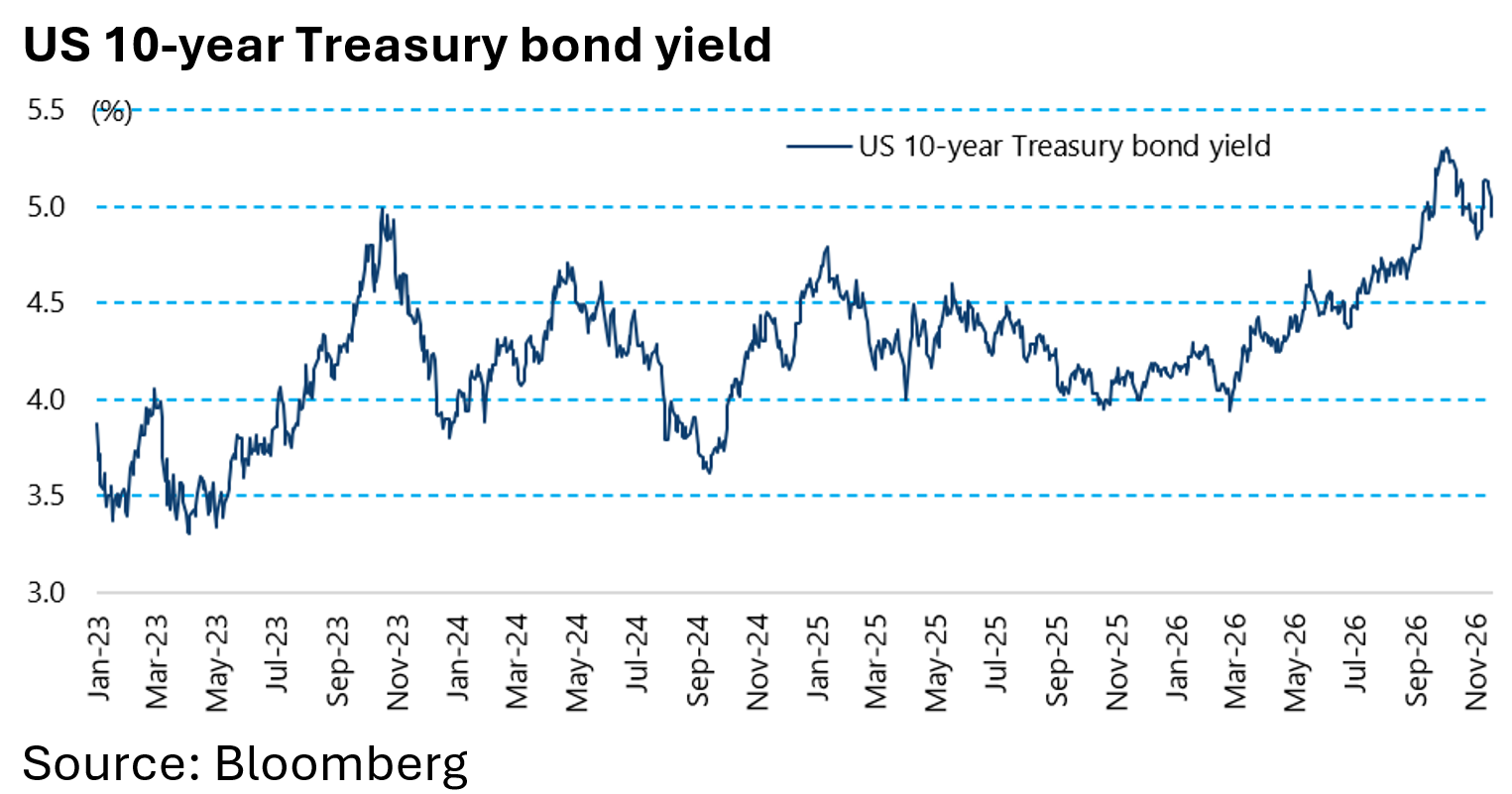
To this writer, the reason why is a risk premium driven by growing fiscal concerns, or rather that the US has entered an era of “fiscal dominance” to cite a currently fashionable term.
What is certainly clear is the latest US data reflects renewed fiscal deterioration.
Net interest payments and entitlements accounted for an annualised 98.4% of total federal government receipts in the 12 months to October.
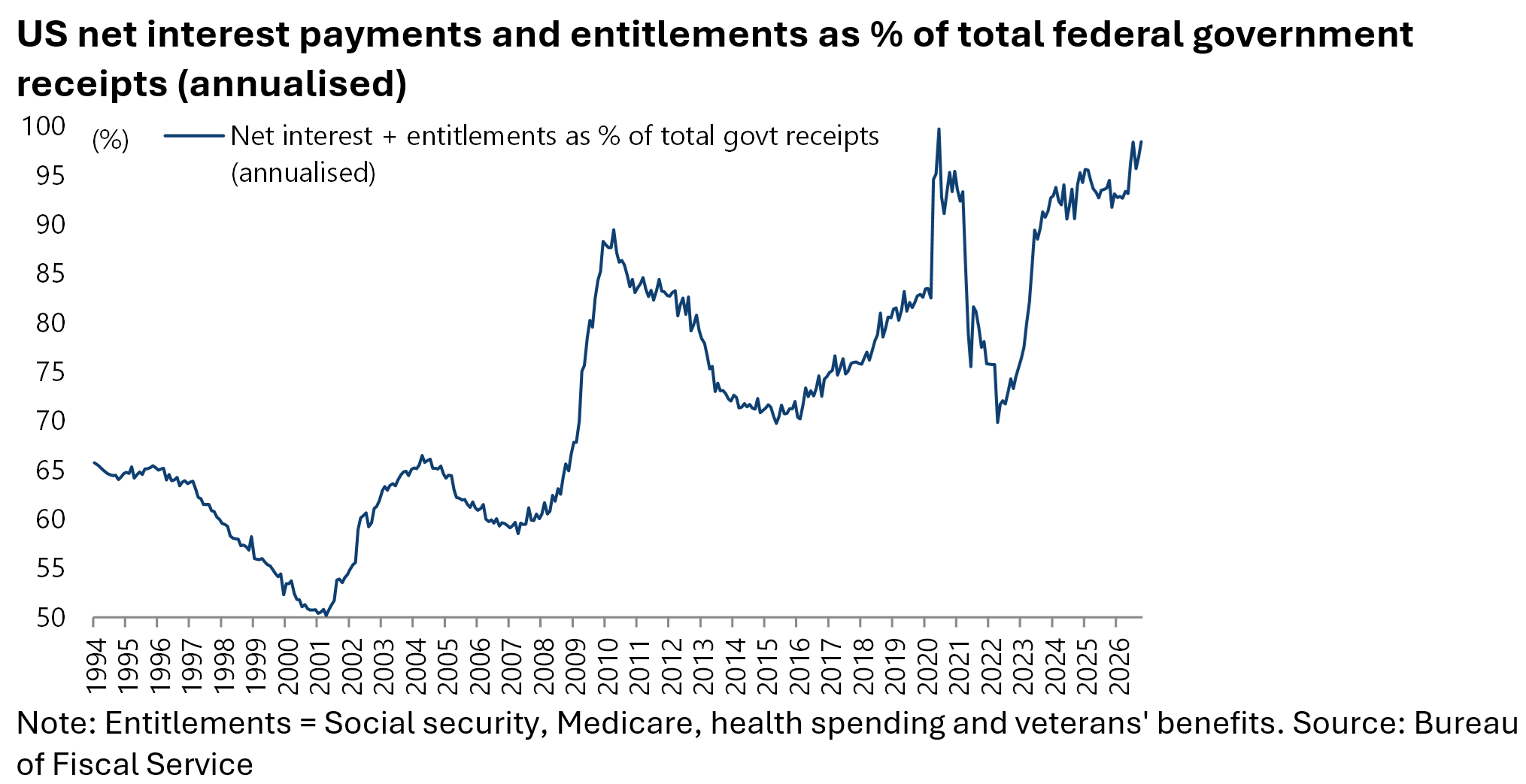
This is the second highest annualised level on this metric ever after the 99.7% recorded in the 12 months to June 2020 at the peak of Covid.
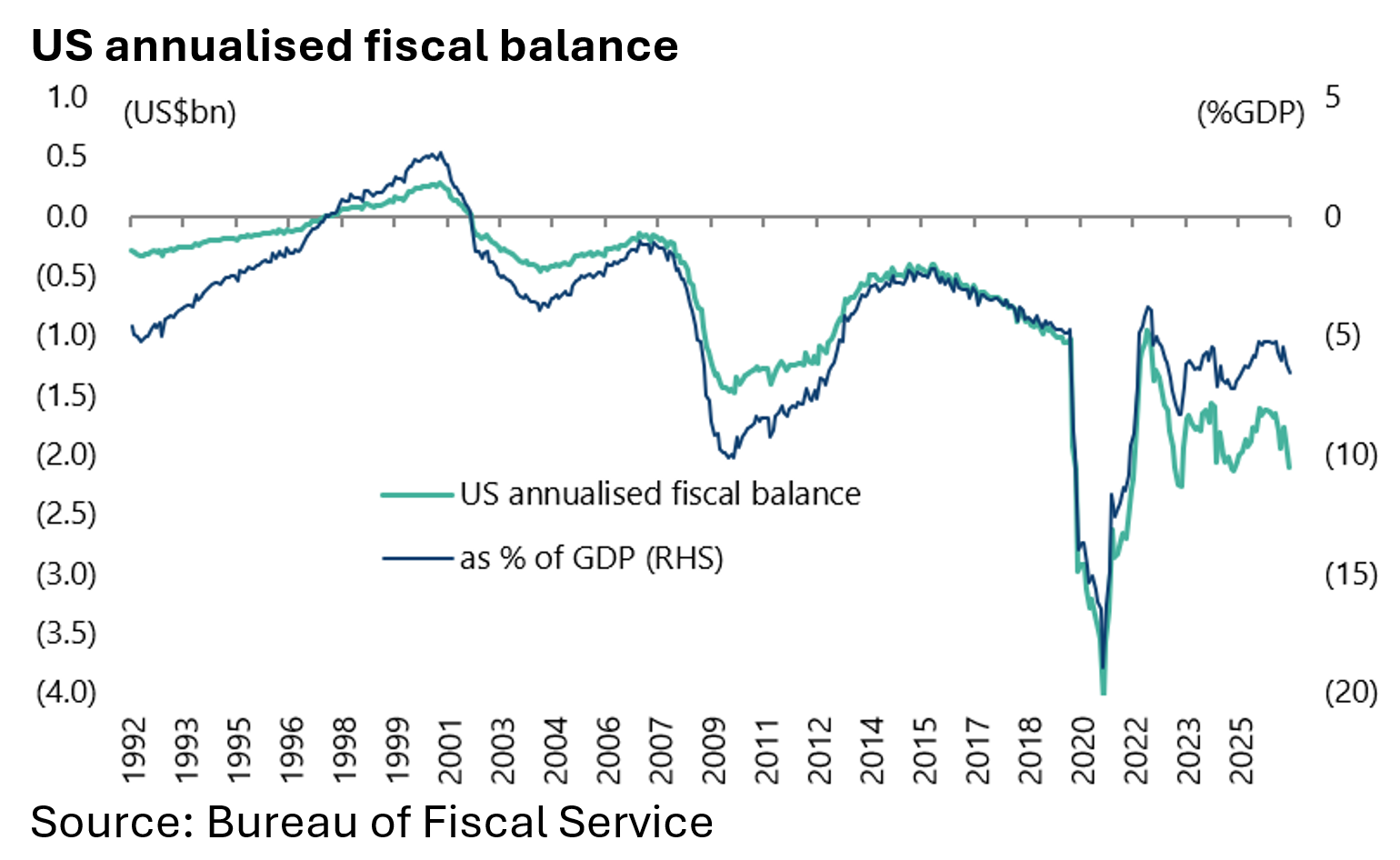
With the US fiscal year ending at the end of September, the FY26 deficit was US$1.99tn or 6.2% of GDP.
As for the October data, the deficit rose further to an annualised US$2.11tn or 6.6% of GDP in the 12 months to October, with the October deficit rising to US$404bn, the highest deficit ever for the month of October compared with US$284bn in October 2025.
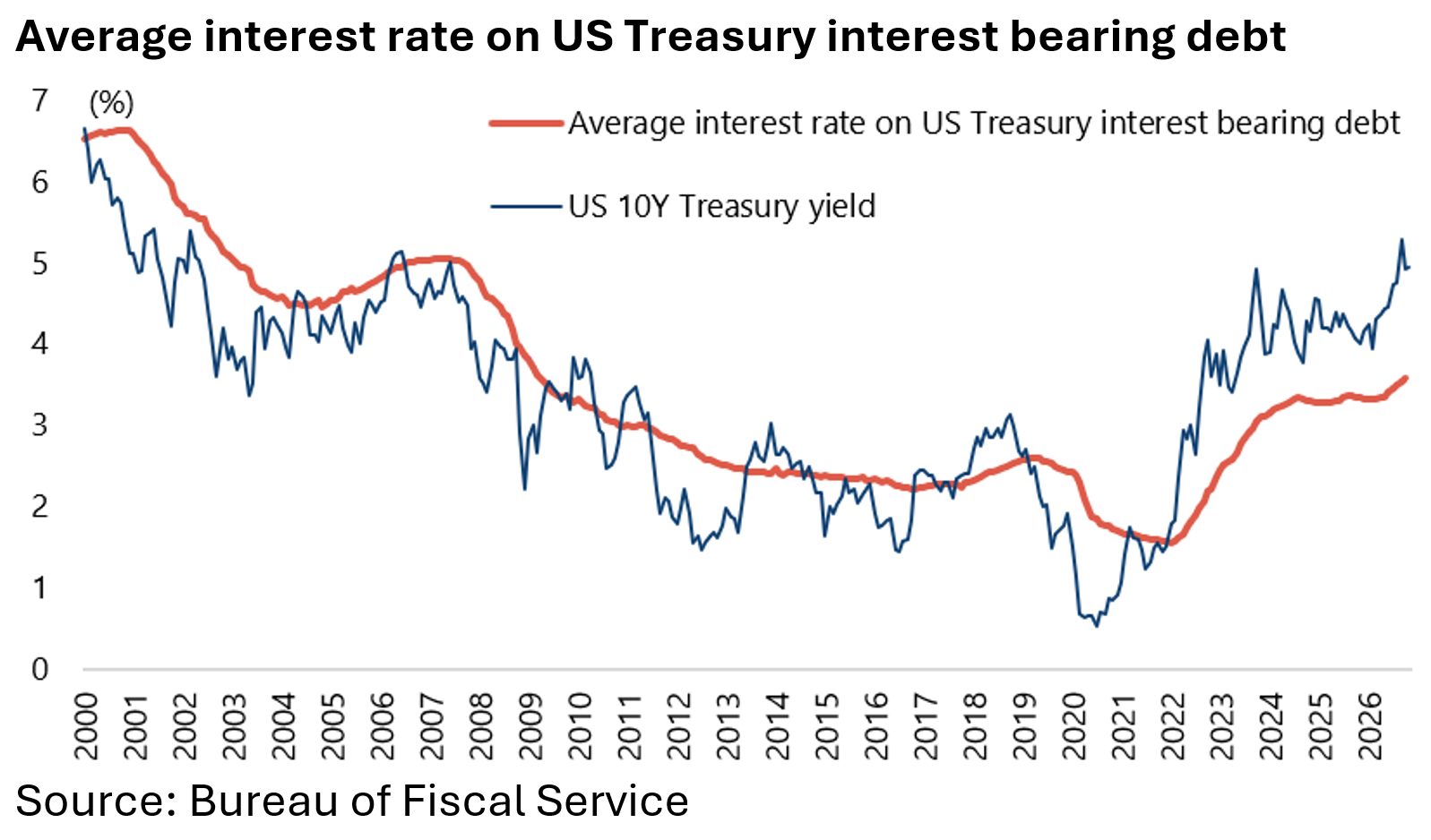
The debt servicing bill, or net interest payments, also rose to a record US$1.064tn in the 12 months to October. The average cost of financing the Treasury debt is currently 3.58% and rising.
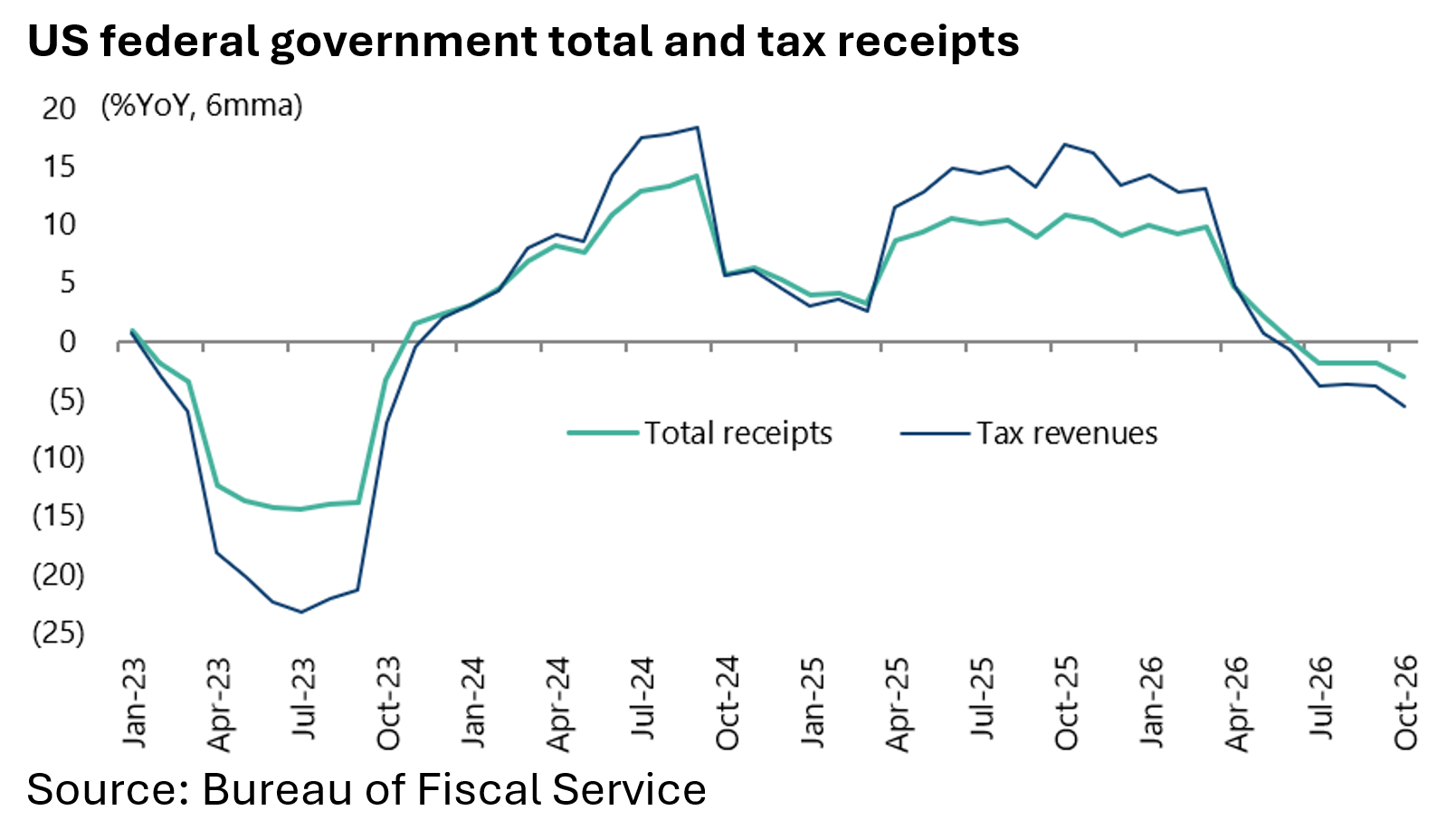
Drilling further into the data, both federal government receipts and, on a narrower basis, tax receipts have seen significant declines of late.
Total federal government receipts and tax receipts declined by 8.8% YoY and 14.6% YoY respectively in October and were down 3.0% YoY and 5.7% YoY in the six months to October, the biggest six-month YoY decline since October 2023, down from a recent high of 10.9% YoY and 16.9% YoY growth in the six months to October 2025.
This comes at a time when the latest Treasury quarterly refunding announcement on 4 November shows scant evidence of ending the ever-growing reliance on funding at the short end.
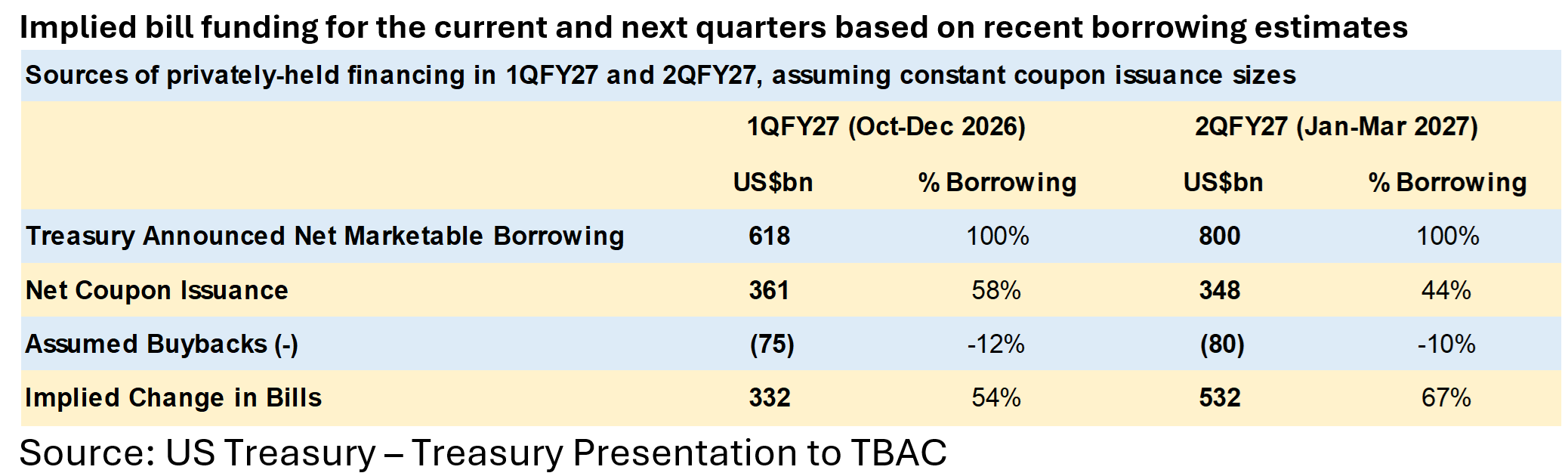
The Treasury announced that it expects to borrow US$618bn in the current quarter ending 31 December. While net borrowing for 1Q27 is expected to be US$800bn, the highest since 3Q25.
The Treasury also repeated the guidance that the Treasury notes and bonds auction sizes will be maintained “for the next several quarters”.
In the Treasury’s presentation to the Treasury Borrowing Advisory Committee (TBAC), the Treasury projects that net issuance of short-term bills will total US$332bn or 54% of the net borrowing of US$618bn this quarter.
While net bill issuance is projected to be US$532bn next quarter, accounting for 67% of the projected net borrowing of US$800bn.
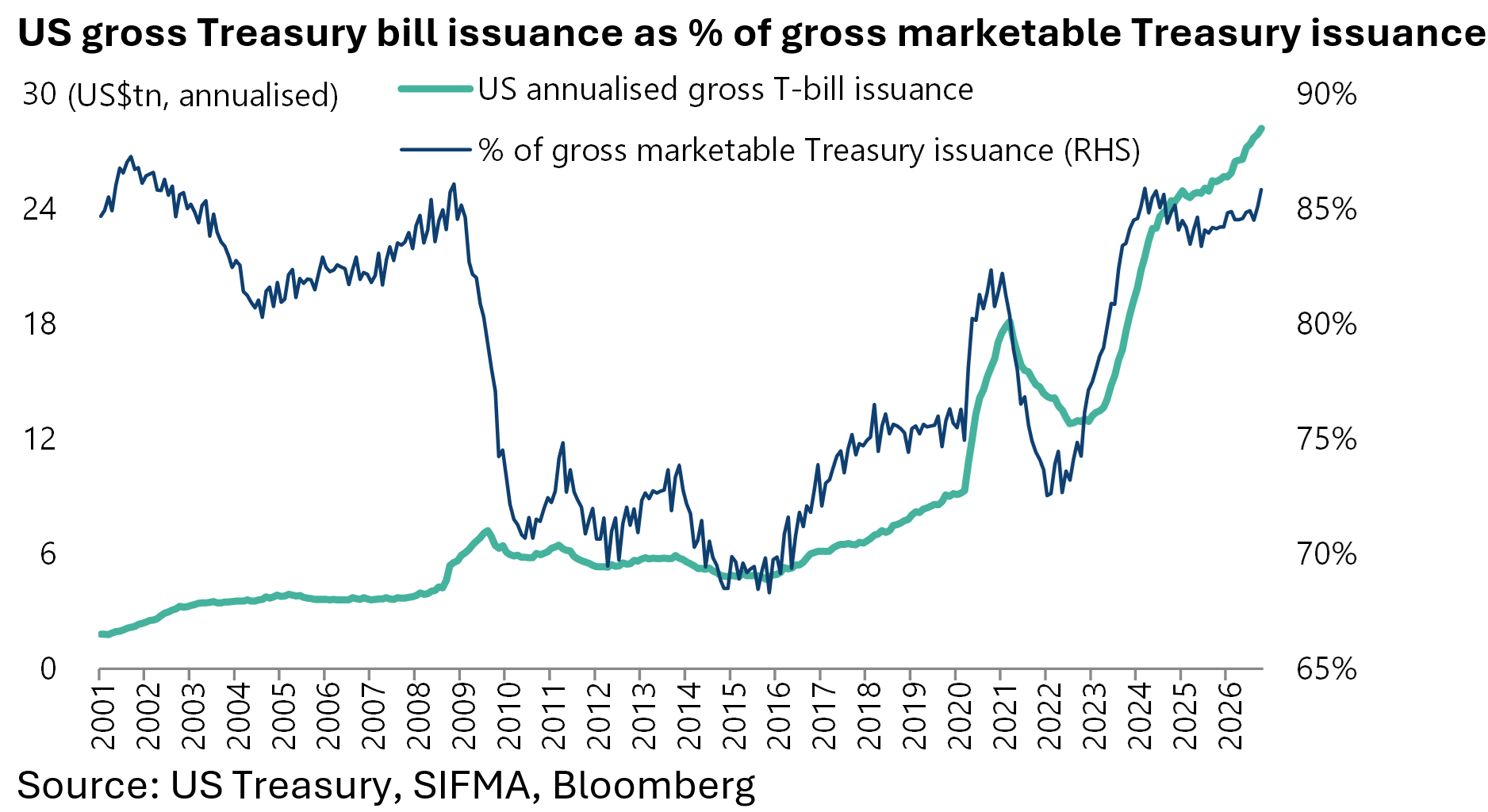
Gross issuance of Treasury bills accounted for 85.8% of gross marketable Treasury issuance in the 12 months to October.
The above deterioration is the reason why this writer’s base case remains formal financial repression in the US is coming sooner or later while, with the Democrats taking control of Congress from 3 January, there will be renewed focus on government shutdowns and the like as regards the US “debt ceiling”.
The current debt ceiling is US$41.1tn while the total public debt subject to the debt limit is now US$40.5tn.
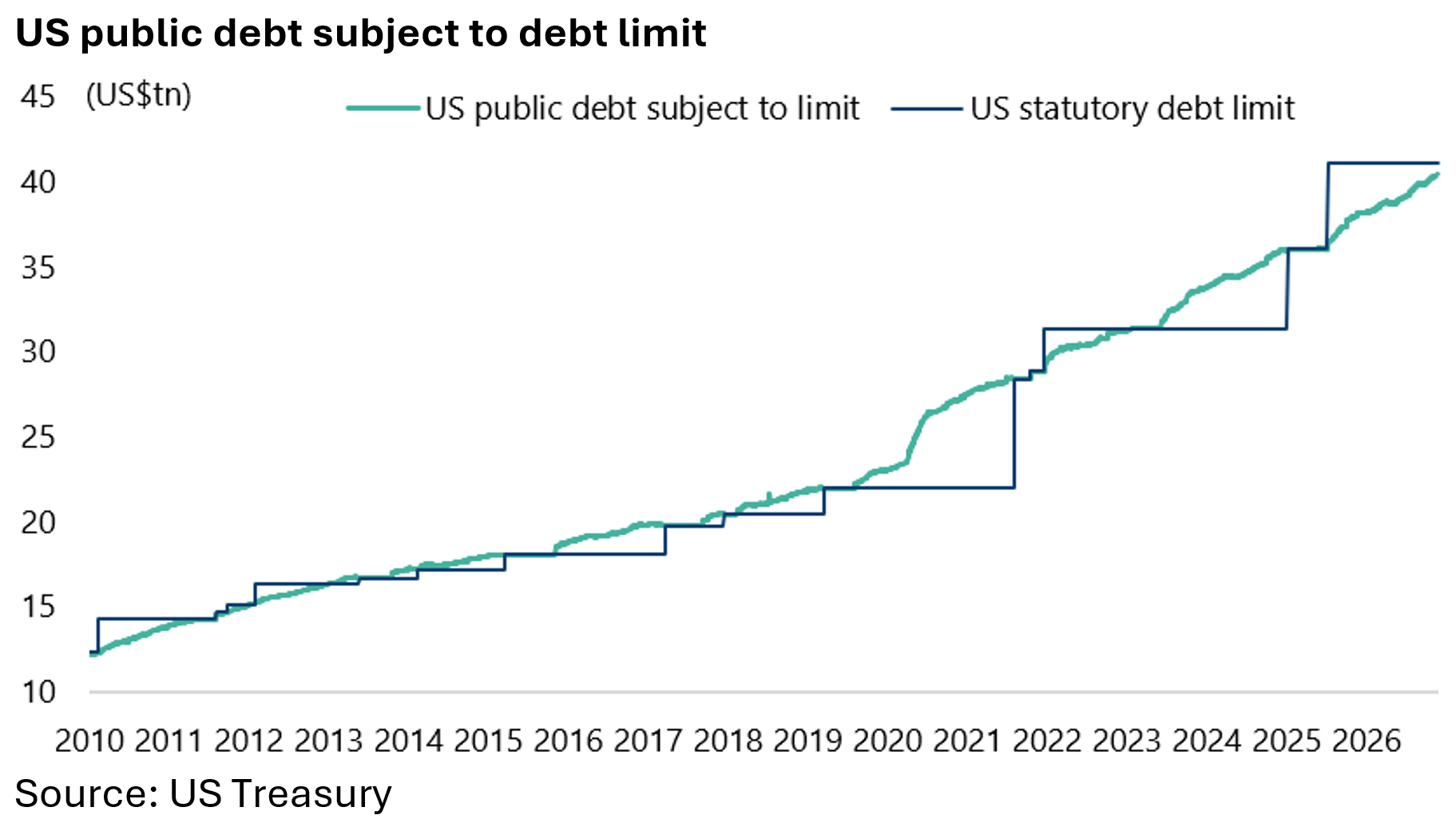
The Bipartisan Policy Center projects that the US will reach the debt limit in February or March next year.
The US Economy Remains Dependent on AI CAPEX
All this comes at a time when growth in the US has become extremely dependent on the AI capex cycle.
It is worth repeating the key points here again.
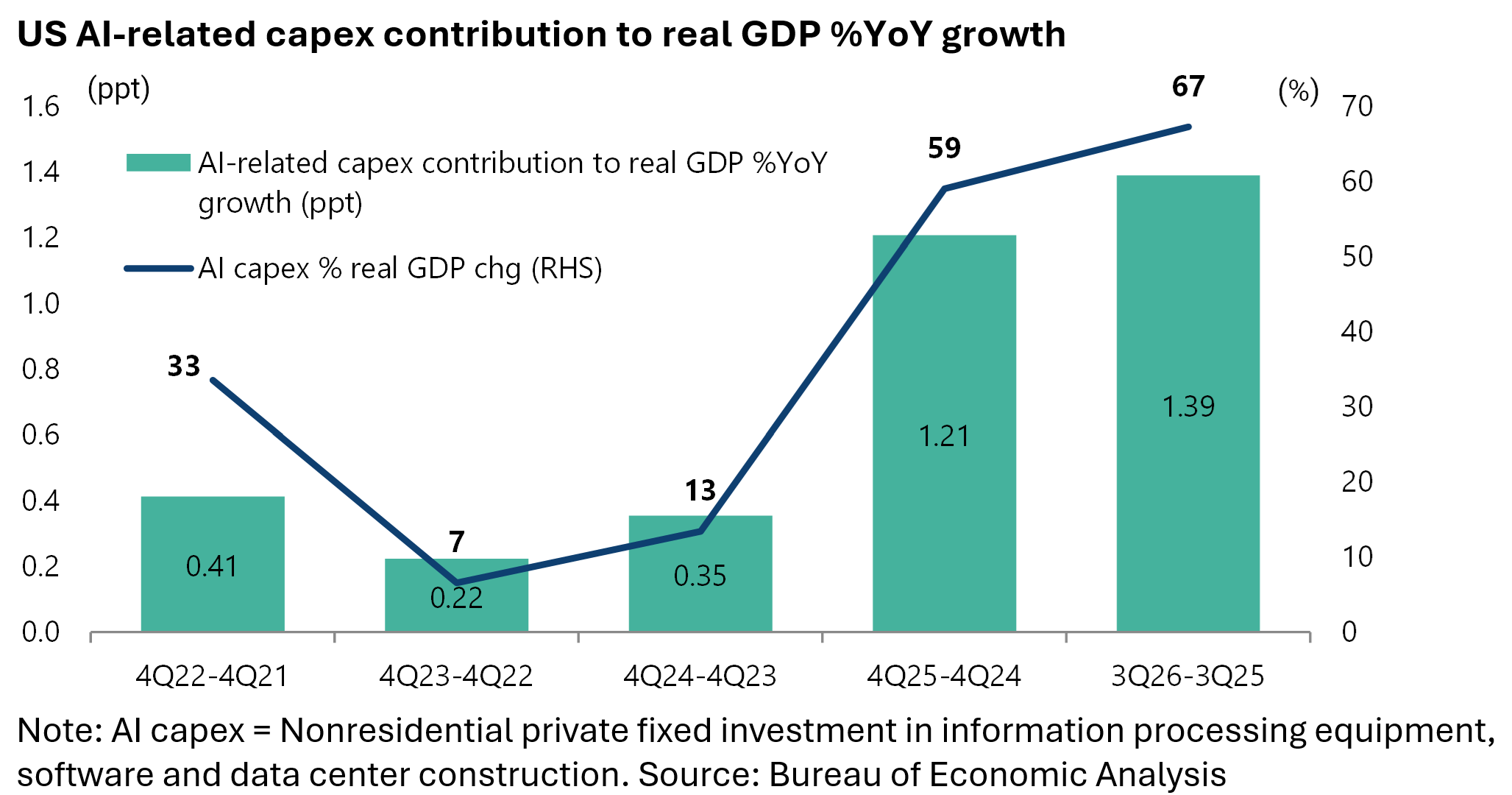
US real AI-related capex, measured as nonresidential private fixed investment in information processing equipment, software and data center construction, contributed 1.39ppts or 67% to US real GDP growth of 2.1% YoY in the four quarters to 3Q26.
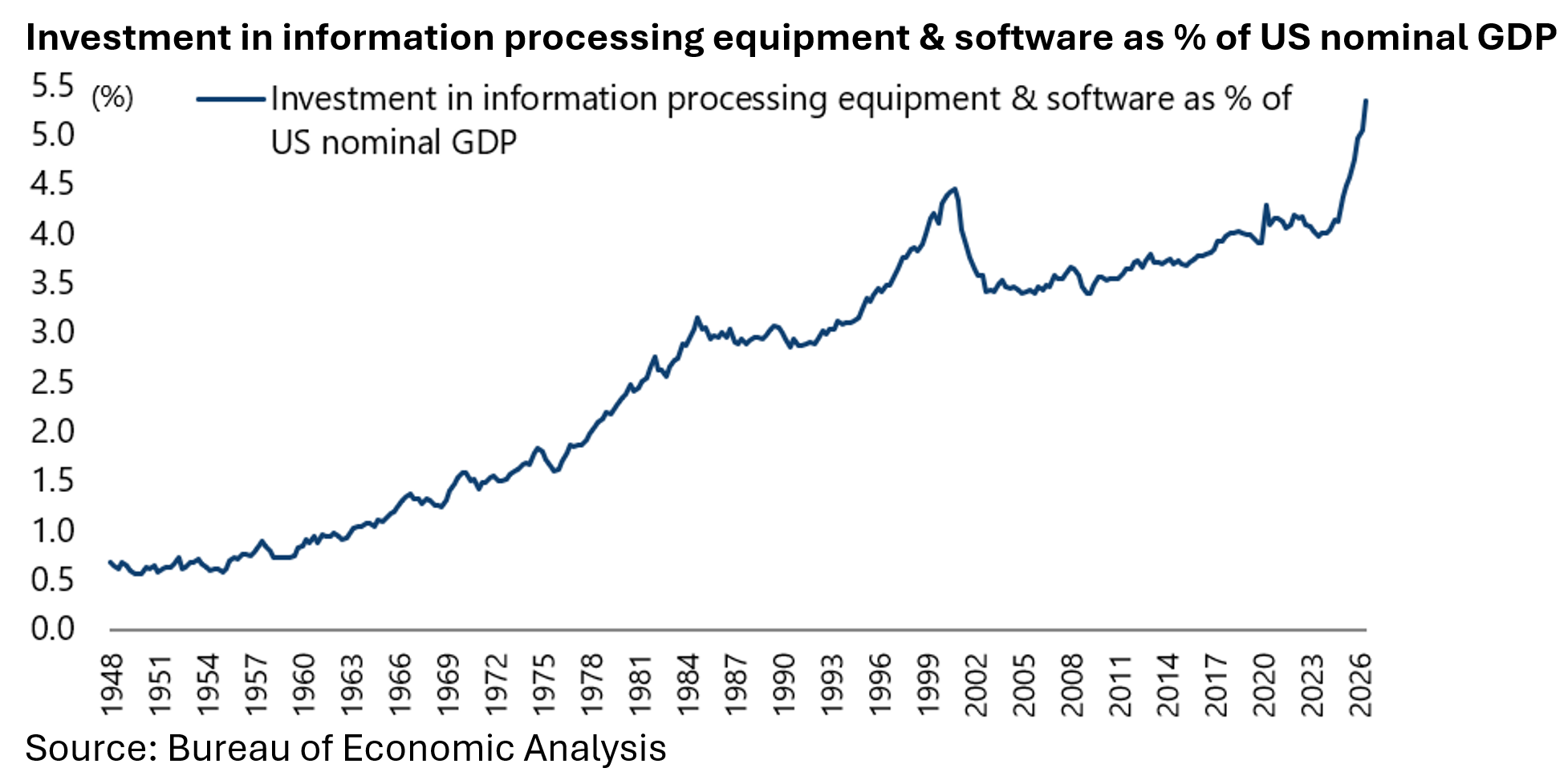
While in nominal terms, the investment in information processing equipment and software as a percentage of nominal GDP rose to a record 5.35% in 3Q26, up from 5.05% in 2Q26, compared with a previous cycle peak of 4.46% in 4Q00 in the dotcom boom.
Finally, as regards the fiscal question, the issue of foreigners’ growing reluctance to finance the US government should not be forgotten.
The three biggest holders in recent years have been Japan, the UK and China with the UK surpassing China as the second biggest since March 2025.
China and Japan No Longer favor US Treasuries
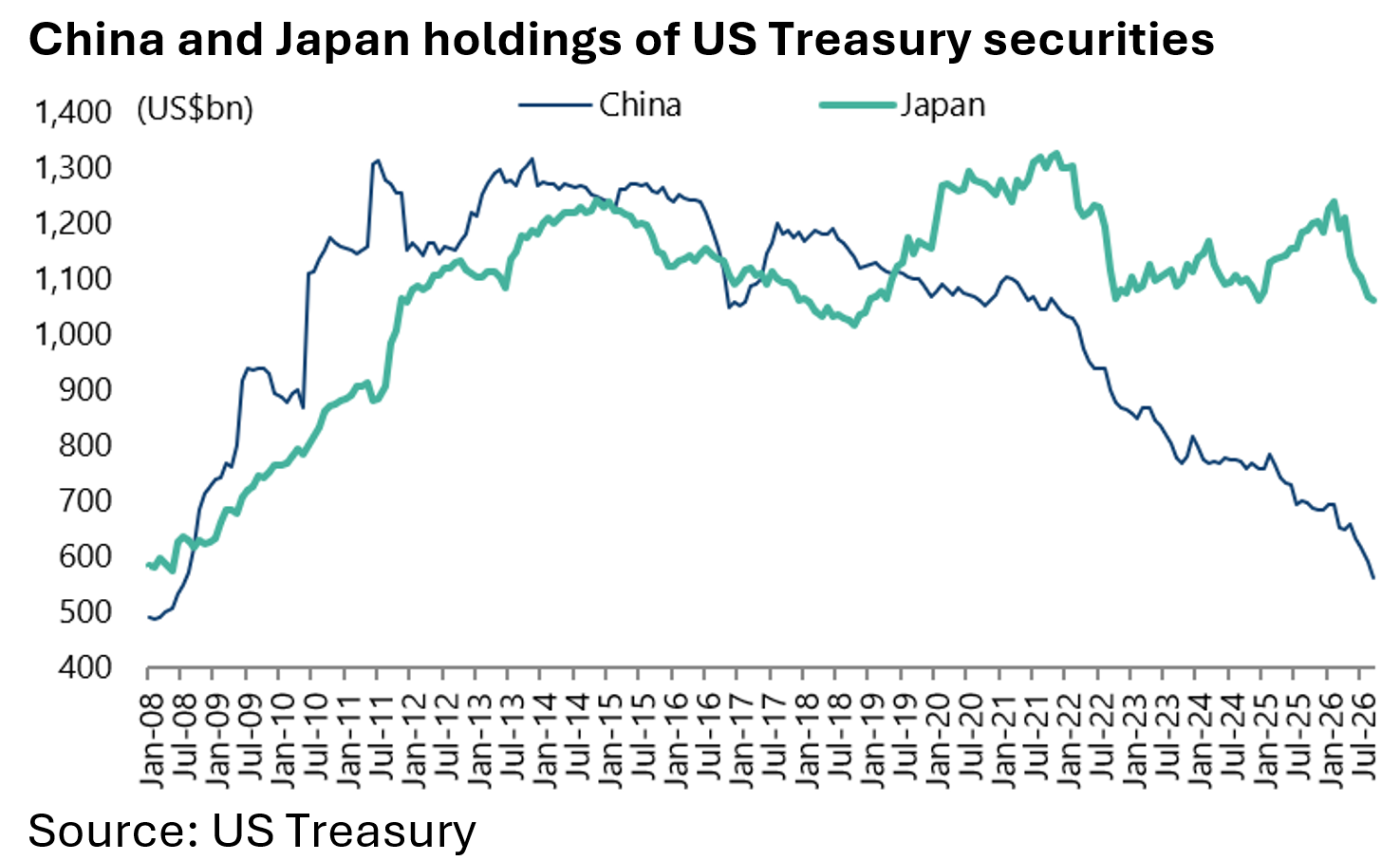
So far, the Chinese have sold down their US Treasuries to a much greater extent than the Japanese.
Indeed, China’s holdings have declined by 57% or US$753bn since peaking at US$1.317tn in November 2013 to US$564bn in September 2026.
By contrast, Japan’s holdings of US Treasuries peaked at US$1.326tn in November 2021 and have since declined by “only” US$262bn or 20% to US$1.063tn in September.
But rising JGB yields at home, with the ten-year yield at 2.8%, and a weak yen, are creating pressures to repatriate more money, though it is also evident that US Treasury Secretary Scott Bessent is putting pressure on Tokyo not to sell.
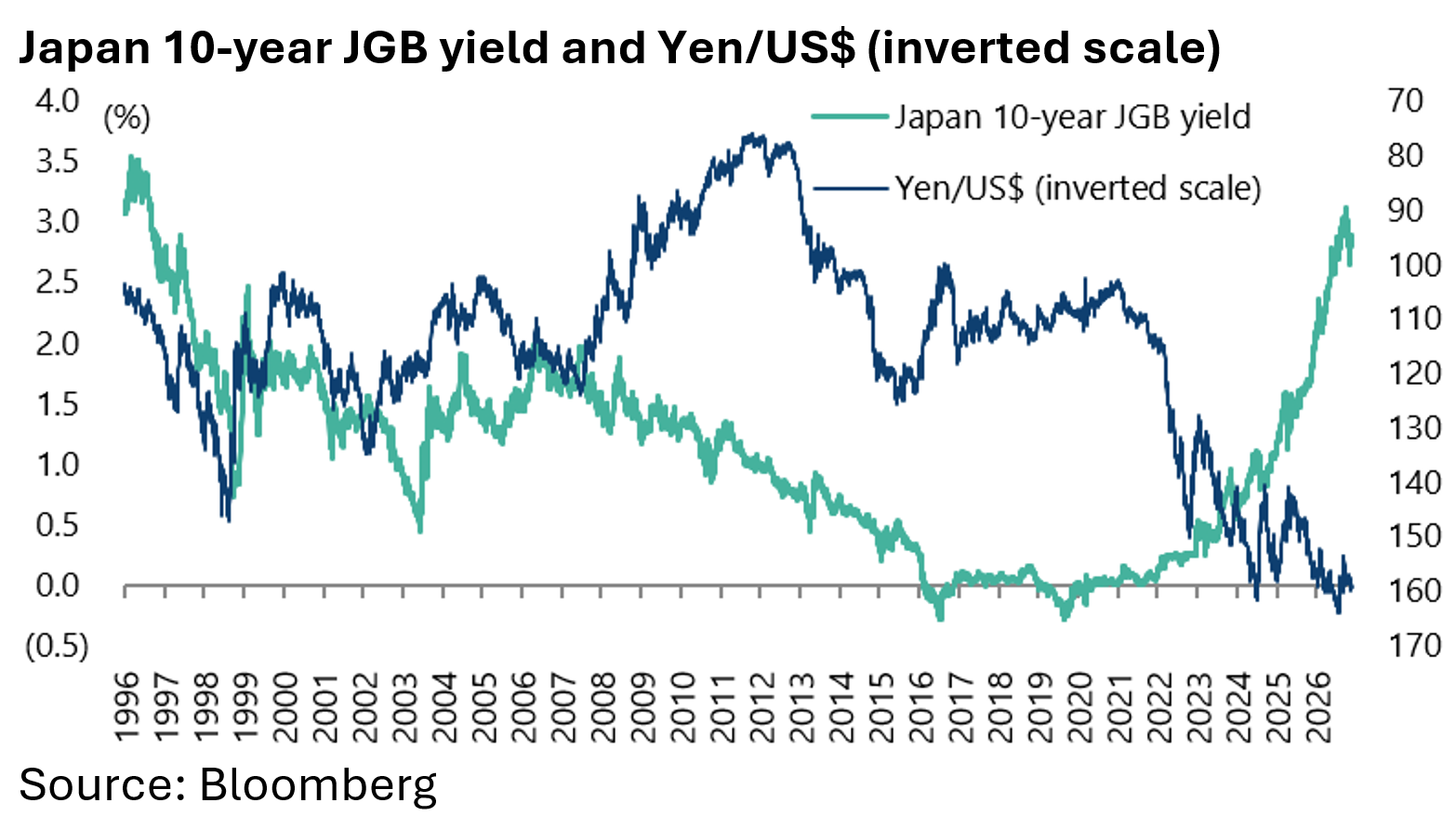
So, China’s approach over the past decade has been incremental in terms of exiting its Treasury holdings when they mature. The risk in Japan’s case is that any sudden need to repatriate creates much more violent market action, in terms of the impact on the long end of the Treasury market.
This is, of course, precisely Bessent’s concern.
The views expressed in Chris Wood’s column on Grizzle reflect Chris Wood’s personal opinion only, and they have not been reviewed or endorsed by Jefferies. The information in the column has not been reviewed or verified by Jefferies. None of Jefferies, its affiliates or employees, directors or officers shall have any liability whatsoever in connection with the content published on this website.
The opinions provided in this article are those of the author and do not constitute investment advice. Readers should assume that the author and/or employees of Grizzle hold positions in the company or companies mentioned in the article. For more information, please see our Content Disclaimer.
About Author